
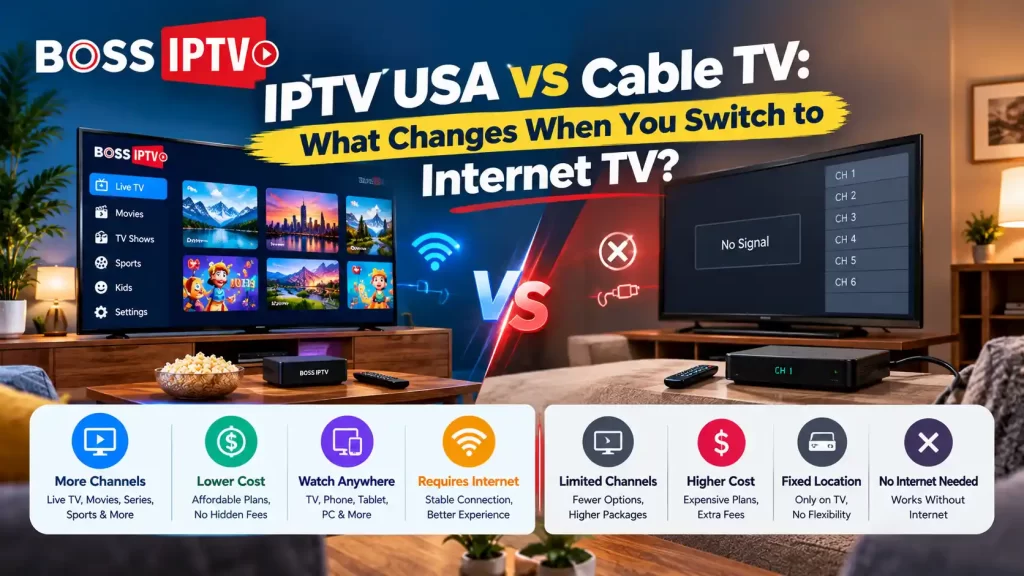
Television bills at American homes have been increasing for decades and now many people think about whether there is any place left for the cable box in their homes. The debate about IPTV USA vs Cable TV is not some kind of technical issue anymore; it’s a decision based on prices, opportunities and habits.
This blog outlines all the differences that occur after TV comes to you via the internet connection, so that you can make a decision based on evidence.
Cable travels through a coaxial cable system that the service provider uses. All subscribers get the same signal and a decoder box decodes it for you. All channels get to you at the same time.
IPTV streams the content to your device through the broadband connection you already have, just as video would stream to your phone. IPTV reacts to what you have asked for. This single difference makes all the difference to on-demand libraries, pauses and rewinds and multiple devices.
Price is normally the very first factor that comes to mind when comparing IPTV USA vs Cable TV service. The price advertised in cable television rarely matches the amount reflected on the invoice, as there are broadcast charges, sports fees, rent and other additional costs.
| Feature | Cable TV | IPTV |
| Monthly cost | $90 to $150 | $15 to $70 |
| Contract | Often 12 to 24 months | Usually monthly |
| Equipment | Rented set-top box | Smart TV, stick or app |
| Installation | Technician visit | Self-setup in minutes |
| On-demand library | Limited | Extensive |
| Multi-device viewing | Restricted | Phone, tablet, laptop, TV |
| Outage risk | Local line faults | Depends on internet quality |
Cable provides reliable HD quality images, although most channels use compressed signals. IPTV is capable of delivering streams in both HD and 4K resolution provided that bandwidth allows for it.
IPTV providers have much more than just domestic channels – they provide international news, regional movies and foreign sports broadcasts. With one subscription you can save money on additional packages offered by cable. However, local broadcasters need a thorough review before switching off your cable.
Get instant access to thousands of live TV channels and a huge on-demand library with zero cost. Experience smooth streaming, HD quality, and fast performance before subscribing.
👉 Start Free Trial NowCable would require an appointment, drilled walls and a box to return once you move out. IPTV will simply need a device that supports the IPTV technology:
Once the application has been downloaded, then one enters the login details provided by the service provider, after which the channel list appears. When one wants to move the service from one room or house to another, it only needs a simple log-in.
Internet TV relies on the connection that supports it. Before you change your plan, keep the following in mind:
Cable TV has its own demerits, like local line problems and disruption during storms, but it doesn’t rely on the speed of your home’s internet connection. This is the reality of IPTV USA vs Cable TV.
Seek out clear pricing, customer service, dependable servers and content licensing information. There is a big difference in quality among different services and therefore the choice is important to make. It makes sense to read independent user reviews before investing any money.
Many users start their IPTV journey with Boss IPTV or some other service. Whatever you prefer, always ask for an IPTV Free Trial. It enables you to test the channel stability, image quality and compatibility with the devices on your network before making payment.
Maintain your cable subscription active until that time in order not to miss anything. Once your new service proves itself reliable during one week of use (including evenings), terminate your cable subscription and save money. Anyone deciding between IPTV USA and cable TV will see how wise this way is.
FAQs
Fill the form to get instant access!